You searched
Painter
Coromaldi Umberto
Are you interested in the sales or the purchase of his artworks?
We buy works of this artist
and of other painters and sculptors from the 16th century to the first half of the 20th century
The Berardi gallery offers a free and without obligation service for evaluation of ancient and modern art . To find your way in the art market, very complex and full of nuances, it is better to rely on a professional consultant who can answer fast and concretely to your needs. The clarity of the answers will resolve effectively the need to estimate or sell an asset.
Contact us immediately without commitment
Answers also in 24 hours:
Coromaldi Umberto
Coromaldi Umberto
Umberto Coromaldi was born in Rome in 1870 and received his first teachings from his stepfather Filippo Indoni, a watercolorist. The latter, noting the talents of his stepson, enrolls him at the Academy of Fine Arts in Rome, where he follows the courses of Filippo Prosperi. He made his debut at the National Exhibition of Fine Arts in Rome with Portrait and Merry Tale, still immature paintings that however anticipate Coromaldi’s address and a preference for lively genre scenes drawn from everyday life.
In 1894 at the Società degli Amatori e Cultori he presented Return of the castaways, a work that allowed him to win the artistic retirement and to make a series of study trips to Europe. The next step towards artistic maturation takes place with the attendance of Antonio Mancini’s studio, from which he draws a predilection for a brighter and more varied palette and the ability to make the scenes represented energetic, alive.
The themes are those of reality, set in domestic interiors, in popular and rural scenarios, always treated with a clear attention to reality. He took part in the Florentine Exposition of 1901 with Nella birreria and Tristezza, while in Rome, in the same year, he exhibited Il pecoraio and Scena campestre. In 1903 he took part in the Venice Biennale with La Vela and The Mirror and the Woman and in that of 1905 with First Successes and In Solitude. Being well versed in the watercolor technique, again in 1905, he joined the Society of Watercolors of Rome, exhibiting at their reviews until 1915.
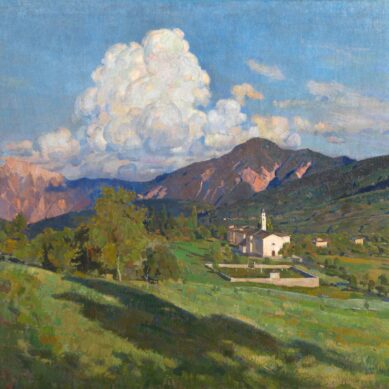
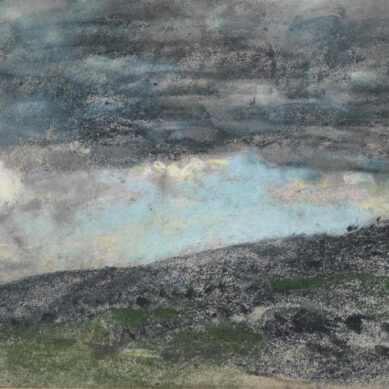
In the first decade of the twentieth century, a very particular sensitivity for the landscape of the Roman countryside grew in Coromaldi, as can be seen from the canvases he exhibited in Milan in 1906: The nurse – Monte Sabino, Alla fontana – sui Monti Sabini, Gli amici – Monti Sabini and Frattaroli. Genre scenes, very intimate and treated with a certain poetry, also given by the happy chromatic combinations, appear at the 1907 Biennale, with Ninna nanna, Il son and Nella capanna.
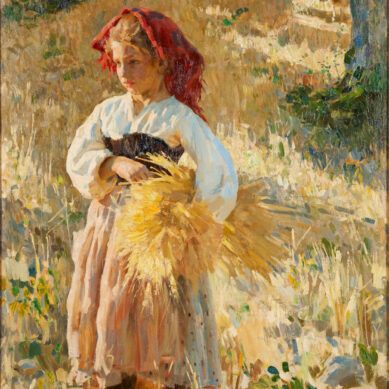
The theme of fatigue, of working in the fields, captured with an evocative, melancholic vein, but closely linked to the real thing, returns throughout the production dedicated to landscape studies. It is no coincidence that at the very beginning of the twentieth century, with the nickname of “Cephalus” he entered the group of XXV of the Roman Campagna.
The sheepfold in the mountains appears at the National Exhibition in Rome in 1911, in which Coromaldi also deals with the decoration of the Fishing Pavilion with emblems related to fishing. Participations in the Venice Biennale are constant: in 1912 he exhibited On the road to the source, in 1920 Estate and Black and White, in 1922 At the Manger and All the sheepfold and finally in 1924 Hours of Peace and Green Harmonies.
Do not forget his participation in the exhibitions of the Roman Secession of 1913, 14 and 15, in which he presents works of great lyrical impact such as Return from the Harvest and Summer Morning. He continues to paint and participates in predominantly Roman exhibitions, up to the 1930s, such as the first and second Rome Quadrennial, in which he exhibits Alpine Village, Child and La siesta nel pollaio. After his appointment as president of the Academy of San Luca, he died in Rome in 1948.