(Roma 1903 - 1993)
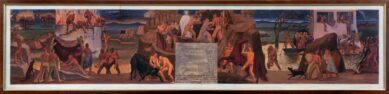
Sketch for the Capannelle Fire Brigade Memorial (1942)
Measures: cm 30 x 135,5
Technique: Mixed technique on paper applied to plywood
Signed and dated with dedication in the bottom centre: “Sketch for the Fire Brigade Shrine – in the schools – at Capannelle – to dear Teodoro and Ada Baruffi in memory. A. Achilli. Rome. October 1942”.
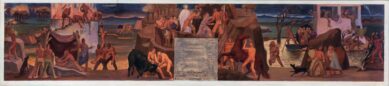
In the early 1940s, Achilli was responsible for the frescoes for the semi-elliptical shrine of the Central Fire Brigade Schools at Capannelle, inaugurated in August 1941.
In designing the fresco, which covers an area of 80 square metres on one of the room’s curved walls, Achilli decided to depict several episodes featuring the protectors and rescuers of mankind, subjected over the millennia to the impetus of overwhelming natural events.
The dramatic and allegorical development of the composition makes the figures strongly expressive, at the centre of disastrous events and heroic demonstrations. Although the sketch, made in mixed media on paper applied on plywood, is similar to the final rendering, there are also some substantial differences that give us valuable evidence of the artist’s original project.
In common with the fresco is the tripartite course of the decoration: on the left is the description of catastrophes produced by the fury of fire in an ancestral prehistoric world, from which emerge singular and incisive reminiscences of the priscorum hominum vita described by Piero di Cosimo (1462-1522) in the late 15th-century decorations executed in the Florentine home of the merchant Francesco del Pugliese. In the panels dedicated to human life before the advent of Vulcan and thus before the control of fire, Piero depicts men and animals living together and fleeing agitated by the flames of the forest, just as in the Achilli decoration. Thus opening up to a brilliant and original primitivism, the painter adopts a formalism akin to that of 15th century Florence, while remaining in line with the compositional tendencies of other artists of the Roman School such as Giuseppe Capogrossi (1900-1972) or Gisberto Ceracchini (1899-1982).
The two desperate figures fleeing from a grotto also fit into this antiquing context and recall the desperate gestures of Adam and Eve driven from Paradise painted by Masaccio in the Brancacci Chapel in Florence. This scene, incidentally, represents one of the most visible differences from the preparatory cartoon: in it, in fact, the primordial couple fleeing is missing, while the man held in the arms of two rescuers remains, but positioned in the opposite direction, in a clear reference to Raphael’s Deposizione Borghese.
In the background of the preparatory cartoon, there is also a building covered in flames that some men try to extinguish with buckets of water, a scene that is not present in the final version, in which Achilli has preferred a certainly more primitive setting, with archaic huts built among the trees and rocks.
The figures in the sketch, although poorly defined, present the same energy and narrative vivacity as in the fresco, a detail that is also clearly visible in the part on the far right of the panel, in which the tragedy of the floods is narrated, which in the fresco is more crowded with figures than in the sketch, in a sort of horror vacui in which men, women and children, terrified by the power of the water, take shelter or run away as best they can. Once again, the author inserts several quotations from antiquity, including a boy who flees carrying his elderly father on his shoulders, like the group that evokes the passage of Aeneas with Anchises on his shoulders from Raphael’sIncendio di Borgo , from which he also borrows the emblematic nude figure desperately hanging from the window, present in the sketch but not in the monumental finished work.
In the central portion, the fulcrum of the allegory, modern humanity appears, no longer saved by the heroes and exempla virtutis of primitive civilisations, but by the institution of the Fire Brigade, which embodies the same will to protect human lives. Despite the celebratory intent in accordance with the regime’s demands, conveyed by the constant heroic nudity of the figures and the solemn rhythm of the central figures, both the sketch and the fresco are permeated by an emotional and at times intimate narrative, which reveals the personal contribution of the artist, sensitive to a lively and erudite expressionism.
In the fresco, the activity of the vigilantes is supervised and protected by the figure of Saint Barbara placed above them, who in the sketch almost physically accompanies them on their mission to rescue some people in a cave. To the sides of Saint Barbara and the Vigili, in both compositions, appear two animals, a bull and a horse, subjugated by human strength and intellect, in the final and liberating perception of finally being rescued from the vehement fury of nature.
Elena Lago